


What Causes Sewer Line Backups, and How Can You Prevent Them?
The Short Answer on Sewer Line Backups
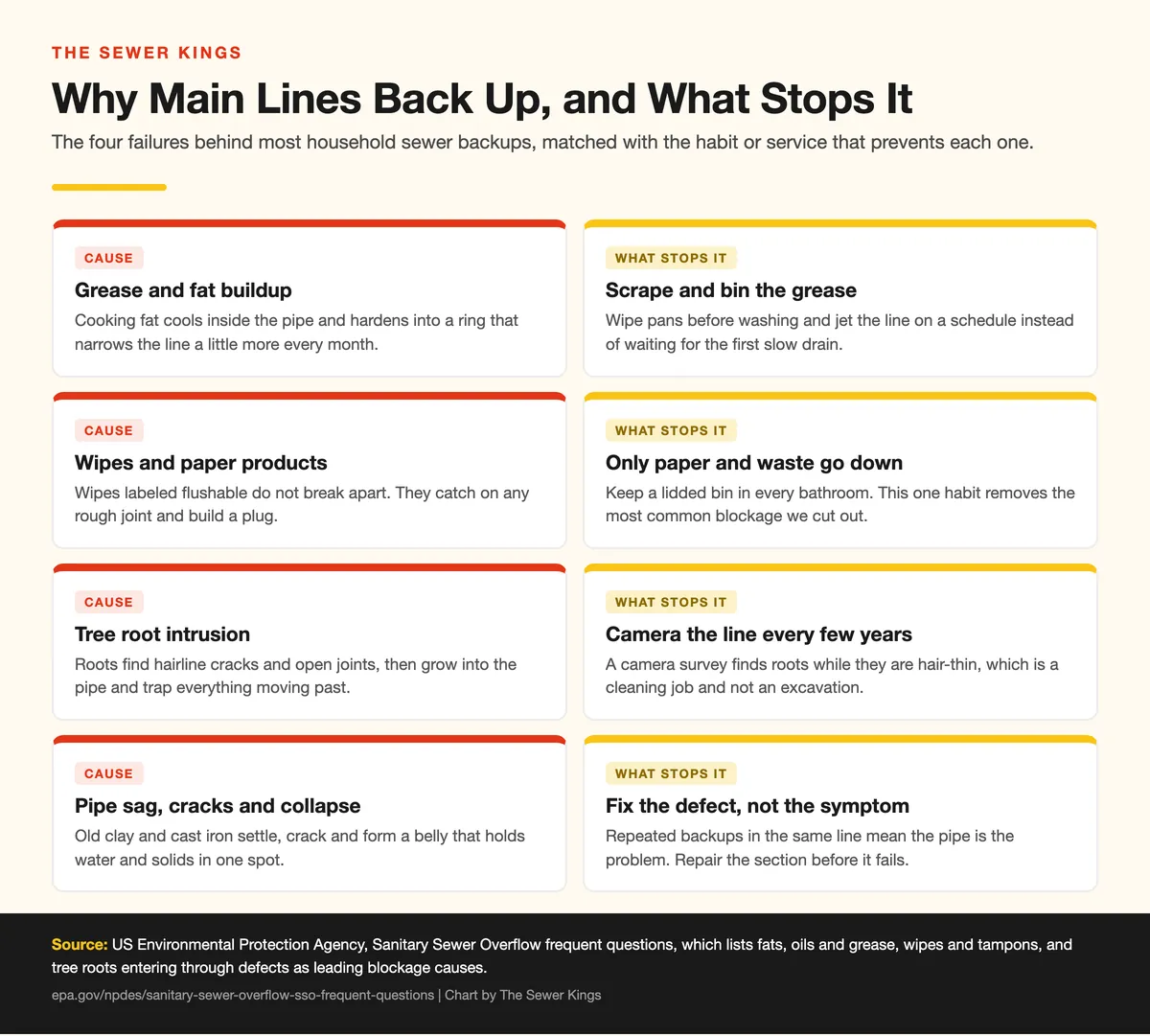
Almost every sewer backup traces to one of four things. Grease, wipes and paper products, tree roots, or a pipe that has cracked or sagged.
The US Environmental Protection Agency lists the same short set of culprits. Fats, oils and grease, household products marked flushable, and tree roots entering through defects are named as leading causes of blockages in sanitary sewer lines. You can read the agency’s own list in its sanitary sewer overflow questions.
The Sewer Kings open blocked lines every week, and the pattern almost never changes. Three of the four causes are stopped by a habit and a schedule. The fourth one is a pipe defect, and no habit will fix it.
Below is what each cause looks like, the signals that show up before a full backup, and what to do the moment waste comes back up the drain. If your line has already blocked twice, the pipe is talking to you. Book a sewer line inspection and find out what is down there before it happens again.
The Four Things That Cause Almost Every Backup
A main line does not close overnight. It narrows for months while the house keeps flushing, and then one ordinary load of laundry pushes it over the edge.
Grease and cooking fat
Hot fat goes down the sink as a liquid and cools in the pipe as a solid. It clings to the wall and builds a ring that gets thicker every month. Kitchen lines and older clay laterals collect it fastest, because the joints give it something to grab.
Wipes, paper towels and hygiene products
Toilet paper falls apart in water. Wipes do not, even the ones sold as flushable. They snag on a rough joint, catch the next thing that passes, and build a dam. This is the blockage our crews pull out most often, and it is the easiest one to stop.
Tree roots
Roots follow moisture. A hairline crack or an open joint gives them a way in, and once inside they spread into a net that traps solids. A cable cuts them at the wall and they grow back. Removing them properly means clearing the pipe and then fixing the defect that let them in.
A cracked, sagging or collapsed pipe
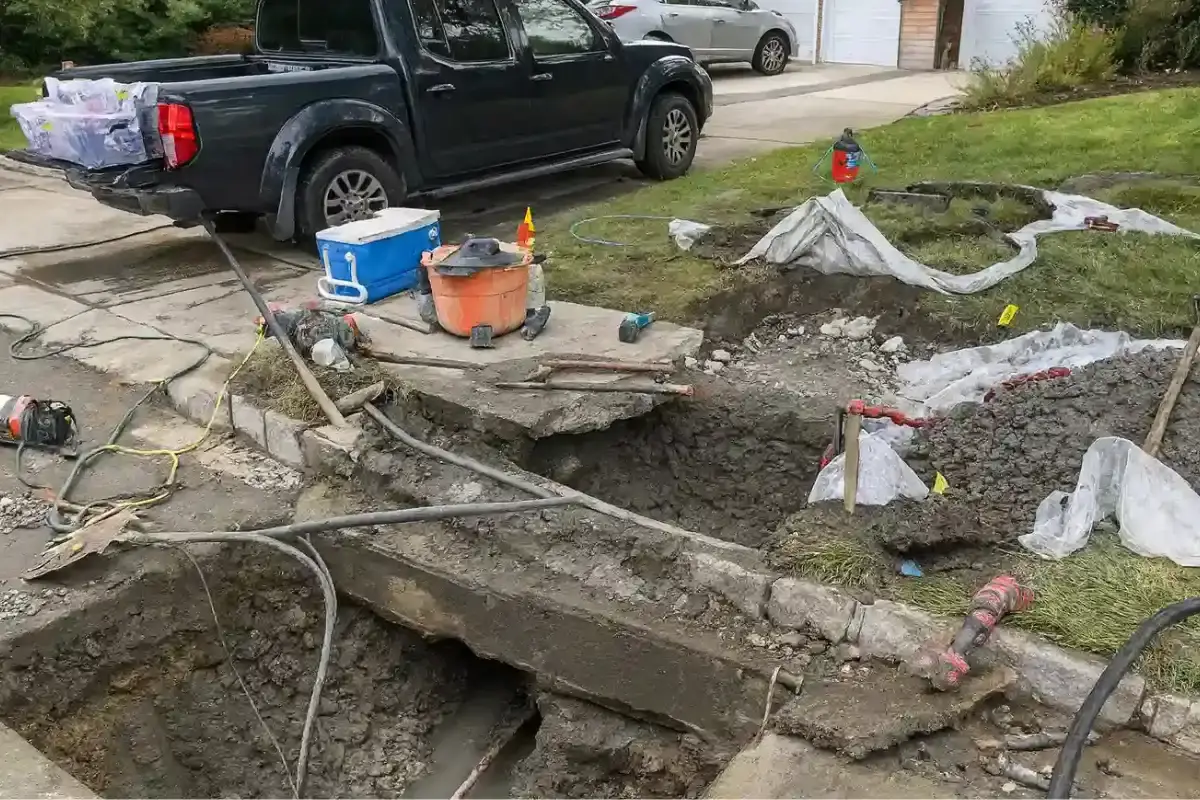
Old clay and cast iron settle over time. The line develops a low spot that holds water and solids in one place, or a section cracks and lets soil in. When this is the cause, cleaning buys a few months at best. Our companion guide on what causes a main sewer line backup walks through how the system fails one part at a time.
How to Prevent a Sewer Backup at Home
Prevention is cheap and boring. A backup is expensive and memorable. Four habits carry almost all of the benefit.
Keep grease out of the drain
Pour cooled fat into a can and bin it. Wipe greasy pans with a paper towel before they hit the sink. Hot water and dish soap do not solve this. They just move the grease a few feet down the line before it cools.
Put a lidded bin in every bathroom
Only human waste and toilet paper belong in a toilet. Wipes, cotton pads, dental floss and hygiene products all belong in the bin. One bin per bathroom removes the single most common blockage we cut out of residential lines.
Know where your trees are
If a mature tree sits within about twenty feet of the line, roots are already looking for it. That does not mean cutting the tree down. It means putting the line on a camera every couple of years so roots get caught while they are still thin.
Put the line on a cleaning schedule
A line that gets cleaned on a set cycle rarely surprises anybody. A line that gets cleaned only when it backs up will back up again. Booking professional drain cleaning on a schedule costs a fraction of an emergency call and a floor cleanup.
The Warning Signs That Come Before a Full Backup
A main line gives you notice. Homeowners usually notice the signs and explain them away, because each one on its own looks minor.
A toilet that gurgles when the washing machine drains is the clearest early signal. Air is being pushed back up the line because water cannot get past something. That is a main line problem, not a toilet problem.
Two or more fixtures draining slowly at the same time points the same direction. One slow sink is a branch line. A slow sink, a slow tub and a slow toilet together means the trouble sits downstream of all three.
Water showing up where it should not is the last warning. A basement floor drain that wells up during a shower, or a soft wet patch in the lawn above the line, both mean waste is looking for the easiest way out.
Smell counts too. A sewer odor inside the house or over one spot in the yard usually means a cracked pipe is venting where it should be sealed.
What to Do the Moment a Backup Starts
Stop using water first. Every flush, every load of laundry and every shower adds to what is already coming up. Tell the whole house, not just yourself.
Keep people and pets out of the water. Raw sewage carries bacteria and viruses, so it is not a mop-and-move-on situation. If water is anywhere near outlets or a furnace, cut power to that area at the panel.
Skip the drain chemicals. They rarely reach a main line blockage, they sit in standing water, and they make the job harder and less safe for the technician who arrives.
Take photos before anything is cleaned up. Water damage is one of the most expensive claim categories in home insurance, and the Insurance Information Institute puts the average water damage and freezing claim near fourteen thousand dollars in its homeowners insurance facts and statistics. Documentation is what gets that paid.
Then call. A camera goes down the line, the blockage gets cleared, and the footage shows whether the pipe itself is the problem. When it is, our sewer line repair service handles the section that failed, and our guide to repair versus replacement cost explains where the price break falls.
The Sewer Kings answer these calls around the clock, because a backup does not wait for a weekday. Anthony and Mark Papaneri built the company on their father’s water and sewer work, and the crew still treats a Sunday call the same as a Tuesday one.
Sewer Line Backups: Common Questions
Am I responsible for the sewer line, or is the city?
In most towns you own the lateral, which is the pipe from your house to the connection at the main. The city owns the main in the street. That means a blockage in your yard is your bill, and a blockage in the street is theirs. A camera survey settles the question fast, because it shows exactly where the trouble sits.
Does homeowners insurance cover a sewer backup?
A standard policy usually does not. Sewer and drain backup is normally sold as a separate endorsement, and it is inexpensive compared with what a finished basement costs to replace. Check your declarations page for backup of sewers and drains, and add it if it is missing.
Will a store-bought drain cleaner prevent a backup?
No. Those products are made for a hair clog in a sink trap, not for a main line coated in grease or holding roots. They sit in standing water, they can damage older pipe, and they do nothing about a crack or a sag. A scheduled cleaning does the job the bottle cannot.
Stop the Next Backup Before It Starts
The Sewer Kings camera the line first, clear what is in the way, and tell you plainly whether the pipe needs a repair or just a schedule. Family owned, fully licensed, bonded and insured, and available 24/7 across Burlington, Camden, Gloucester and Atlantic counties.
Call (856) 626-9366 and we will tell you what is actually happening in your line, not what is easiest to sell.