

How Much Does Grease Trap Cleaning Cost?
Real bid numbers, the factors behind them, and what a full cleaning should include for the money.
The Short Answer on Grease Trap Prices
Grease trap cleaning can cost under $200 per visit for a small trap and several thousand dollars for a large outdoor interceptor. Trap size, how full it is, and local disposal fees set most of the price.
There is no single national rate, and anyone who quotes one without asking about your trap is guessing. Real public bids show just how wide the range is.
This guide walks through those numbers and what should be in a fair quote. For service in South Jersey, see our grease trap cleaning service.

What Drives the Cost of a Grease Trap Cleaning
Trap size
A small indoor trap under a sink holds a few gallons. An outdoor interceptor can hold a thousand gallons or more. More volume means more pumping, more hauling and more disposal fees.
How full it is
A trap cleaned on schedule is quicker to pump and scrape. A trap left too long builds a hard grease cap and a thick layer of solids, which takes more time to break up and remove.
Disposal fees
The waste has to go to a licensed site, and those sites charge by the gallon. That fee changes by region and gets passed into the price.
Access
A trap with a clear lid near the parking lot is simple. One under a kitchen floor, behind equipment or far from where the truck can park adds labor.
Emergency timing
A backed up kitchen on a Friday night costs more than a cleaning booked for a slow Tuesday morning.
Documentation needs
Some towns and sewer authorities want written records of every cleaning. A service that includes that paperwork saves you a step at inspection time.
Regular contract or one-time call
Many companies price a set schedule lower than a single visit. A one-time call for a trap that has been ignored often costs the most of all.
Location
Prices change by region. Labor rates, truck travel time and the distance to a licensed disposal site all show up in the final number.

Real Grease Trap Bids, Side by Side
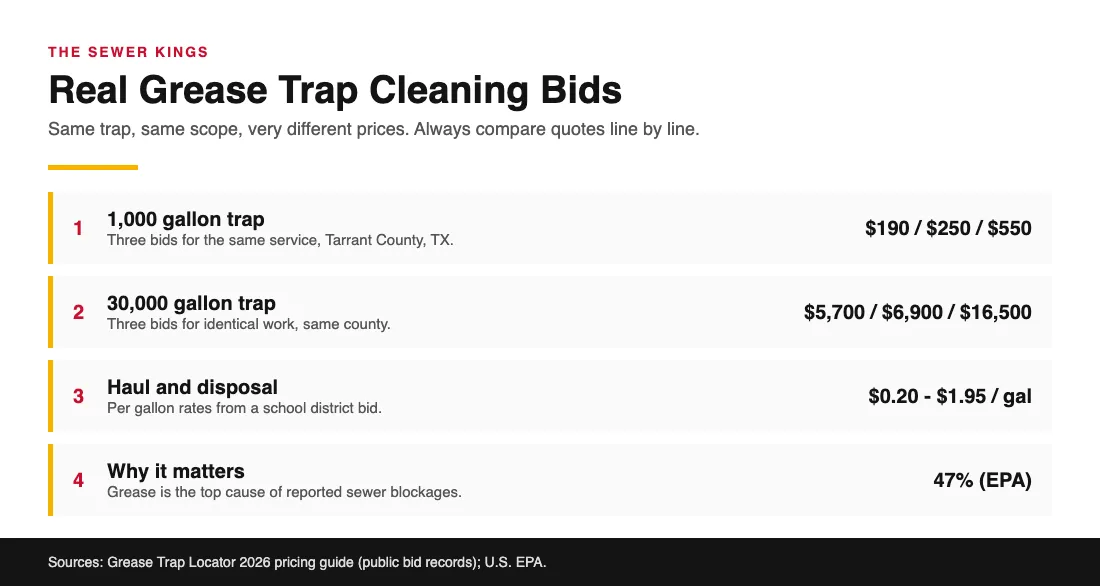
Public contracts show how much prices vary for the exact same job. Grease Trap Locator’s 2026 pricing guide cites a Tarrant County, Texas bid where three companies quoted $190, $250 and $550 per service for the same 1,000 gallon trap.
The same county bid out a 30,000 gallon trap. The quotes came in at $5,700, $6,900 and $16,500 for identical work.
Disposal pricing spreads out too. The same guide cites a school district bid where haul and disposal rates ran from $0.20 to $1.95 per gallon.
The lesson is simple. Get written quotes for the same defined scope from more than one company, then compare them line by line.
Those public bids also show what a written scope does. When every company prices the same defined job, you can see which prices are fair and which are padded.
Ask for the trap size, the service steps, and the disposal fee to be listed separately on each quote. That makes a side by side comparison easy.
What a Full Cleaning Includes From The Sewer Kings
The Sewer Kings clean grease traps for restaurants, diners and food service businesses across South Jersey. Our crew arrives with a vacuum truck sized for commercial traps.
Before pumping, we open the trap and measure the grease cap and the solids depth. That tells us the trap’s condition and helps set the right cleaning schedule for your kitchen.
Then we pump out everything, not just the top layer. After pumping, we scrape the walls, baffles and lid to remove hardened buildup a vacuum alone cannot reach. You also get documentation of the service to show an inspector.
Skipping this work costs more later. The EPA reports that grease from restaurants, homes and industry is the most common cause of reported sewer blockages, at 47 percent. A blocked line from a neglected trap turns a routine cleaning bill into an emergency repair.
A proper cleaning also gives you information. The grease and solids readings we take on each visit show whether your schedule is right, too long, or longer than it needs to be.
If readings stay low visit after visit, the schedule can often be stretched. If the trap is overflowing between visits, it needs to be shorter.
We also check the baffles, inlet and outlet during each visit. A damaged baffle lets grease slip through even when the trap was just cleaned, so catching it early protects the line downstream.
How to Keep Grease Trap Costs Down
Set a regular schedule and stick to it. A busy restaurant in Evesham may need monthly cleaning, while a small cafe might get by with quarterly service. Regular visits keep each cleaning faster and cheaper.
Train your staff to scrape plates into the trash before washing. Less grease going down the drain means the trap fills slower.
Compare quotes on the same scope. Ask if the price includes full pumping, scraping, disposal and paperwork, or just pumping the top.
Keep your own log of each cleaning date and reading. If an inspector asks, you can show the full history in seconds.
Do not let the trap go past its limit to save a visit. A trap that overflows sends grease into the line, and clearing a blocked line costs far more than a routine cleaning.
Ask your cleaning company to note anything unusual they see, like a cracked lid or a damaged baffle, so small problems get fixed before they become big ones.
To set your schedule, read how often a commercial grease trap should be cleaned, and share our list of what not to put down a drain with your kitchen team.
Grease Trap Cleaning Cost: Common Questions
How often does a grease trap need to be cleaned?
It depends on the trap size and how much grease your kitchen produces. High volume kitchens may need monthly service, and smaller ones may go longer. Your local sewer authority may also set a required schedule.
Why do grease trap quotes vary so much?
Trap size, how full the trap is, access, and disposal fees all change the cost. Public bids show companies quoting very different prices for the same trap. Some quotes also leave out scraping or paperwork.
Who cleans grease traps in South Jersey?
The Sewer Kings clean grease traps for restaurants and commercial kitchens from our base in Evesham, NJ. We pump, scrape and dispose of all waste and give you documentation for your records.
Get a Clear Grease Trap Quote
The Sewer Kings measure your trap, clean it fully and hand you the paperwork. Family owned, licensed, bonded and insured, and available 24/7 for kitchen emergencies across Burlington, Camden, Gloucester and Ocean counties.
Call (609) 357-0547 today.