
What Sewer Pipe Materials Run Under Older Marlton Homes

5.0
& Yelp Reviews


Book A Free Estimate
Submit your information below.


Our Reviews

Why South Jersey Trusts The Sewer Kings


Book A Free Estimate
Submit your information below.
The Year Your House Was Built Picked Your Sewer Pipe
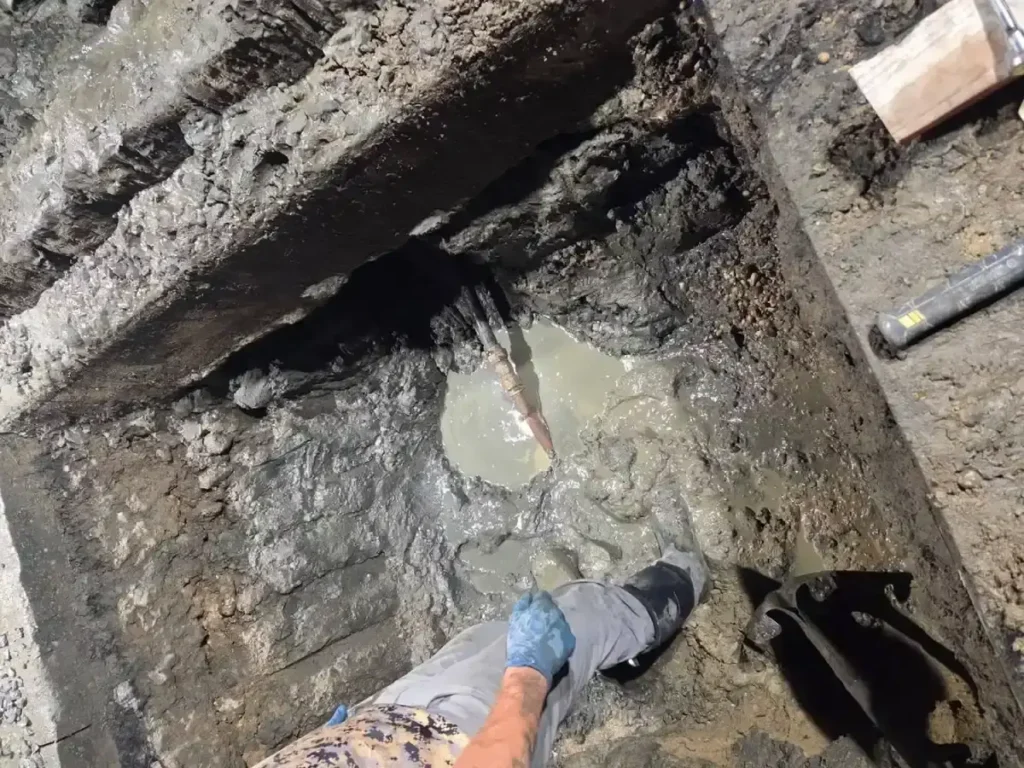
Nobody sat down and chose the sewer pipe under your yard. The builder used whatever was standard the year the house went up.
That one old decision still sets how the line fails, how long it lasts and what it costs to fix. Two houses four streets apart can be two completely different jobs.
Marlton grew in waves, and every wave left a different pipe in the ground. Our sewer line repair crews dig all four of the common ones in the same week.
Here is what went in and when, and how to spot each material. Then what Evesham allows back in the ground when a line comes out.
Marlton Grew in Waves, and Each Wave Left a Different Pipe
Evesham was farmland for most of its life. Census counts show how fast that changed, and the pipe in the ground follows the same timeline.
Before 1950, the Village
Olde Marlton and the farmhouses around it came first. The census counted 2,121 people in the whole township in 1950. Lines from that era are clay or cast iron, and most have been patched at least once.
1950 to 1970, the First Subdivisions
Developers started buying up farms, and the population went from 2,121 in 1950 to 13,477 in 1970. These are the Orangeburg years, and that pipe sits under a lot of ranches and splits from this stretch.
1970 to 1999, the Big Build
The census counted 21,508 people in 1980 and 35,309 in 1990. Census survey figures put roughly two thirds of Evesham’s homes in this window. This is when plastic took over.
2000 and After
About one home in six here went up in 2000 or later. Those lines are PVC, laid to the current rules, and they are rarely the reason we get called.
So the build year is the first clue, and it is usually a good one. A 1962 ranch and a 1994 colonial in the same zip code are not the same repair.
The Four Materials We Pull Out of Marlton Yards
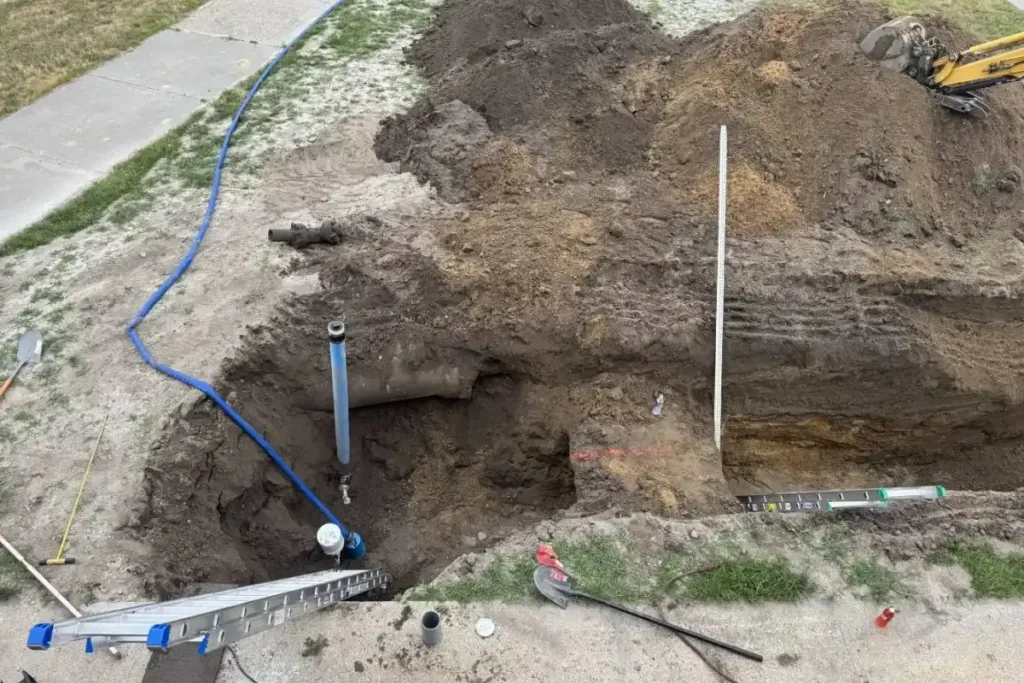
Four materials cover almost every older line in the township. Each one fails in its own way, and the way it fails decides the fix.
Vitrified Clay
Hard, smooth and terracotta colored, laid in short lengths with a bell on one end. Clay does not rust and it does not rot. It fails at the joints, where roots find the gap and pull the sections apart.
Cast Iron
Heavy black or rust colored metal, joined at a hub. It takes the weight of a driveway well. It corrodes from the inside out, so the bottom of the pipe scales over, thins and finally breaks through.
Orangeburg
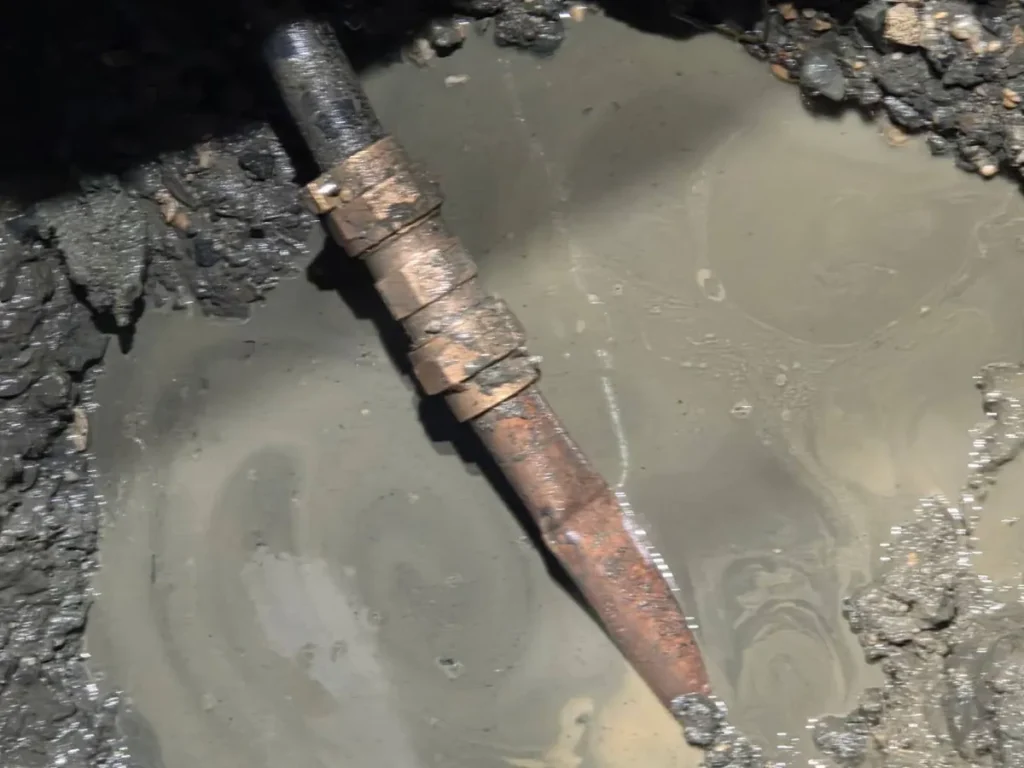
Wood pulp rolled with coal tar pitch, so it is neither metal nor plastic. It went into homes from the mid 1940s until the plant that made it closed in 1972. It does not crack like clay. It squashes into an oval and then closes off.
PVC
White or green plastic in long smooth lengths with glued or gasketed joints. This is what goes in now. When it does fail it is from crushing, a bad bed under it, or roots at a joint. Age alone rarely kills it.
On a 60 year old line we often find two or three of these spliced together. Each owner fixed the piece that broke with whatever was current.
How to Tell What You Have Without Digging the Yard
You do not have to open the lawn to get a good answer. Most homeowners can narrow it to one or two materials in ten minutes.
Start With the Build Year
Your deed or the township tax record gives the year. Before 1970 in Marlton means clay, cast iron or Orangeburg. From the mid 1970s on it is almost always plastic.
Look at the Cleanout
There is a capped pipe behind the curb line, and often a second one where the line leaves the house. What you can see at the cap is frequently what is buried past it.
Go by Color and Feel
Terracotta and smooth is clay. Black or rusty and heavy is iron. Dark brown, rough and a little ridged, close to thick cardboard, is Orangeburg. White or green plastic is PVC.
A Camera Settles It
A cleanout cap can be misleading, because the line past it may change material twice before it reaches the street. A camera run shows where each length starts and stops, and what shape it is in. Our walk through of how a repair day runs at the house covers how the camera run fits the job.
The Sewer Kings cameras the line before quoting a repair in Marlton. Guessing the material is how a one day job turns into three.
What Evesham Lets Us Put Back in the Ground
Replacing an old line is not a free pick of material. The Evesham Municipal Utilities Authority sets what is allowed, and the inspector checks it.
Three Materials Are Standard
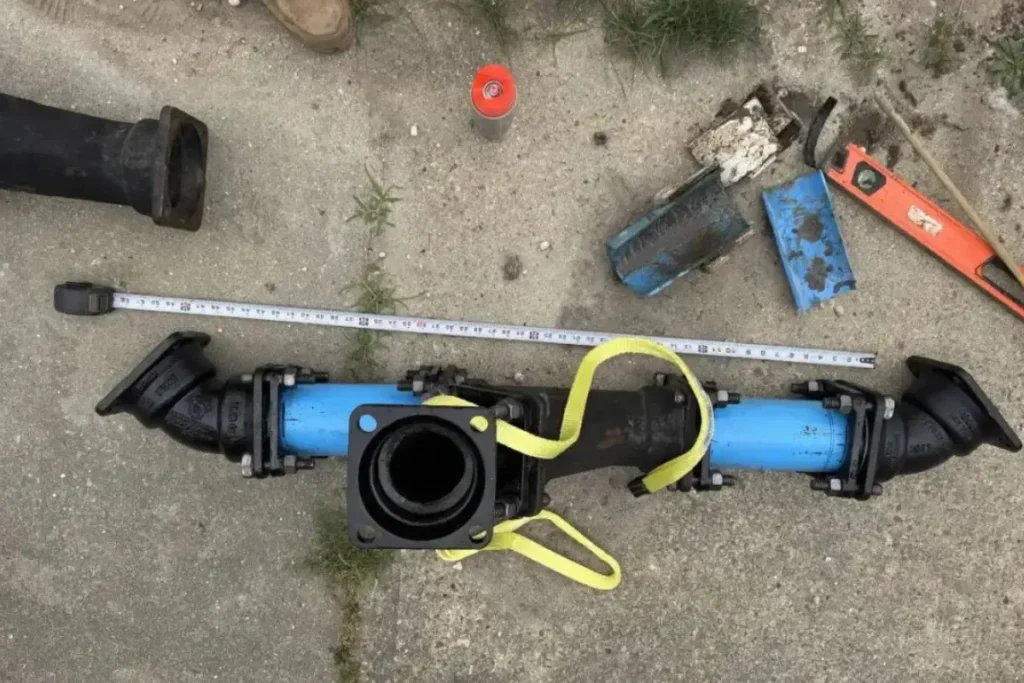
The Authority’s engineering rules say the house service lateral is built of cast iron, ductile iron or Schedule 80 PVC. Anything else needs their written approval before it goes in.
One Material, End to End
The same rules strongly recommend one material from the main all the way to the house. Where a change is needed, iron to plastic for example, the Authority has to approve the adapter.
Size, Fall and Depth Are Fixed
From the main to the cleanout the lateral is at least six inches, in ductile iron or PVC. It is laid at a quarter inch of fall per foot. Cover is at least 36 inches over PVC and 32 inches over ductile iron.
Cleanouts and the Tie In
A cleanout goes just behind the curb, at every change of direction and every fifty feet along the lateral. The connection to the main is a wye, made with a saddle set on the top half of the pipe.
So a 1965 Orangeburg line never goes back as Orangeburg. A cracked clay run is not patched with more clay. Most Marlton homes end up with PVC at the right depth and fall. Our guide to keeping your home usable during a sewer line repair covers the swap from inside the house.

FAQs
Frequently Asked Questions About Sewer Pipe Materials in Marlton
It is usually clay, cast iron or Orangeburg, and sometimes a mix of them. Houses from that stretch went up while all three were in normal use, and later repairs added plastic in places. A camera run is the only way to know which one is where.
Yes, under plenty of homes built between the mid 1940s and 1972. It was never dug up unless it failed. It flattens into an oval instead of cracking. The first sign is usually slow drains that come back after a cleaning.
Not always. Clay in sound condition with tight joints can run for decades. Root intrusion at one joint is often a spot repair. Call The Sewer Kings at (856) 626-9366. We will camera the line and tell you which of the two you have.
Do not wait for a sewer emergency. Call The Sewer Kings at (856) 626-9366 for a free estimate, any hour.


Service Areas
Our Excavation Services Available Throughout South Jersey
Atlantic County
Burlington County
Camden County
Cape May County
Gloucester County

Not Sure What Is Buried Under Your Marlton Yard?
The Sewer Kings is a family run crew, owned by brothers Mark and Anthony Papaneri. We are licensed, bonded and insured, and we answer the phone 24 hours a day.
Call for a free estimate. We will camera the line, tell you what it is made of and give you one price