

Learn the typical cost range
If you are wondering how much does a new sewage line cost, you will find a broad range of answers. According to industry data, many homeowners spend about $3,319 on average, though some pay as little as $225 or as much as $10,000. Good news: this can be more manageable when you understand the components that drive up or lower the bill. Length, depth, and the level of damage all factor in. You may also find that partial fixes, like replacing only a damaged section, can be significantly cheaper than a full overhaul.
Factor in labor and excavation
Labor and excavation typically claim the biggest slice of your budget. Plumbers can charge between $150 and $500 per hour, and the more complex the job, the more hours they will need. If your line sits under a driveway or behind walls, you might need an excavator or demolition crew. That can cost $400 to $1,200 for every 100 feet of digging. Repairs directly underneath or through concrete sometimes run $300 to $350 per linear foot. If your system has collapsed, you may be interested in reading how long does it take to repair a collapsed sewer line? for more insights.
Trenchless methods can sidestep deeper digging and often cost anywhere from $60 to $250 per linear foot. If you decide to minimize excavation, you could learn more about whether a sewer line can be replaced without digging.
Consider materials carefully
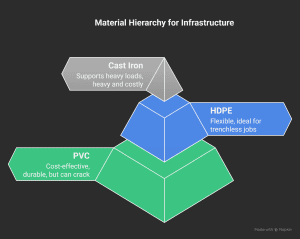
Material choice strongly affects cost and performance. PVC (Polyvinyl Chloride) is usually the most affordable, lasting about 100 years before replacement. HDPE (High-Density Polyethylene) is slightly pricier up front, but it can handle shifting soil and trenchless installations with ease. Cast iron is valuable in high-load areas, such as under driveways, but it is heavier, pricier, and not as common for full-line replacements.
Below is a quick view of typical material options:
| Material | Notable Benefit | Potential Drawback |
|---|---|---|
| PVC | Durable, cost-effective | Can crack if poorly laid |
| HDPE | Flexible for trenchless jobs | Higher initial cost |
| Cast iron | Supports heavy loads well | Heavy, more expensive |
Choosing the right material can save you from frequent repairs. If you want to see why certain pipes drive up your bill, check out why is replacing a sewer line so expensive?.
Plan for extra fees
Permits, local regulations, and post-repair fixes also add to your final bill. Permit costs fall between $30 and $500, depending on your municipality. You may need to repair any torn-up flooring, drywall, or concrete afterward, which can add up fast. Demolition can run from $2.00 to $17.00 per square foot, plus you will need cleanup and restoration. If your line is older or near the end of its life, you might check what is the average lifespan of a sewer line? to see if a full replacement is worthwhile.
Recap and next step
When estimating your new sewage line cost, weigh factors like labor rates, excavation needs, and the choice of pipe materials. Expect higher bills if your project involves deep digging or major demolition. PVC tends to be the most budget-friendly option, while HDPE and cast iron come with specialized benefits that can be worth the extra cost in certain situations.
If you want to keep costs in check, talk to a reliable plumber or contractor, gather quotes from multiple sources, and ask about partial or trenchless repairs wherever possible. Good news: planning strategically now can save you stress and money down the road. When you are ready, pick your first step, gather those estimates, and move forward with confidence. You have more control than you realize, and the numbers can work in your favor with the right approach.