


How Often Should You Have Your Drains Cleaned?
The Short Answer on Drain Cleaning Frequency
Most homes do fine on a cleaning every 18 to 24 months. Houses with big shade trees, a garbage disposal in daily use, or older clay pipe usually need it yearly, which is the same window we recommend in our guide to professional drain cleaning frequency.
Restaurants and commercial kitchens are a different animal. Those lines carry so much cooking fat that cleaning becomes a monthly or quarterly line item rather than a repair call.
The reason the interval matters is what builds up between visits. The US Environmental Protection Agency names fats, oils and grease, wipes marked flushable, and tree roots entering through defects as leading causes of blockages, and you can read the full list in its sanitary sewer overflow questions.
The Sewer Kings keep most residential customers on a set cycle for exactly that reason. Below is the schedule broken down by household type, plus the signs that say move your next drain cleaning forward.

Why a Set Interval Beats Waiting for a Clog
A drain line does not fail suddenly. It narrows slowly, month by month, until an ordinary Tuesday pushes it past the point where water can get by.
Cleaning on a cycle catches that narrowing while it is still a cleaning job. Waiting for the blockage means paying for the same cleaning plus whatever the backup did to the floor.
The difference is not small. The Insurance Information Institute puts the average home water damage and freezing claim at $13,954 for the years 2018 through 2022 in its homeowners insurance facts and statistics, and about one insured home in sixty files that claim each year.
There is a second benefit that nobody sells. A crew that cleans your line on a cycle sees the same pipe repeatedly, so a new crack or a growing root mass gets noticed while it is still cheap to fix.
That is the whole argument for drain maintenance as a scheduled service rather than a phone number you keep for emergencies.
Your Cleaning Schedule by Household Type
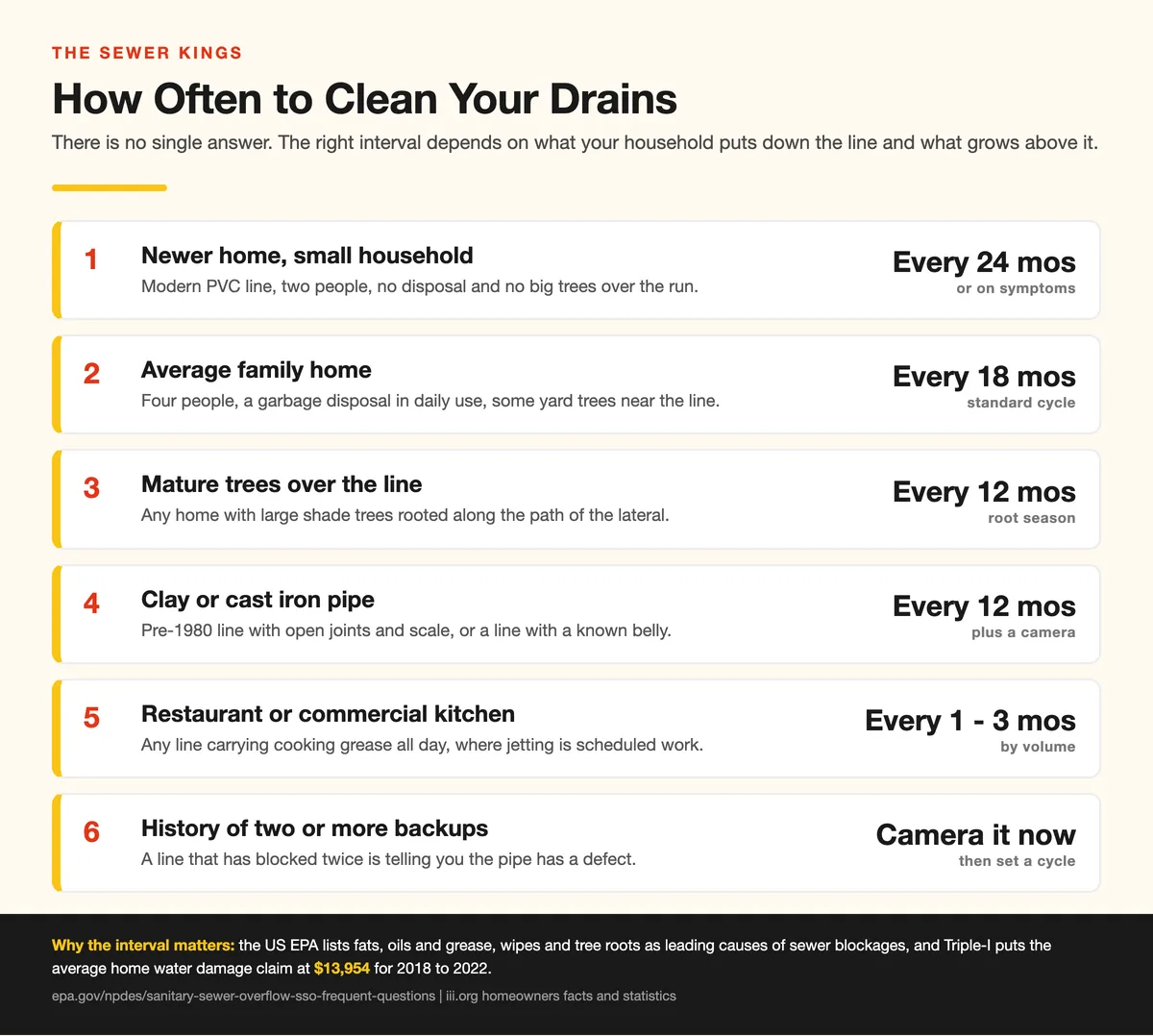
Find the description that matches your house. If two of them fit, use the shorter interval.
Newer home, small household
Modern PVC line, one or two people, no garbage disposal and no large trees over the run. Every two years is plenty, and symptoms should be your real trigger.
Average family home
Four people, a disposal that gets used daily, a few yard trees near the path of the line. Every 18 months keeps this house out of trouble, and booking it as scheduled drain maintenance costs less than the same visit made in a hurry.
Mature trees over the line
Any home with large shade trees rooted along the lateral should go yearly. Roots grow fastest in spring and fall, and a yearly visit catches them while they are still thin enough to flush out.
Clay or cast iron pipe
Pre-1980 lines have open joints and rough walls that grab everything passing through. Go yearly, and put a camera down every second or third visit so you are watching the pipe and not just the flow.
Restaurants and commercial kitchens
Grease volume decides everything here. A busy kitchen line often needs jetting monthly, a quieter one quarterly. This is scheduled maintenance, budgeted like any other operating cost.
Any home with a history of backups
A line that has blocked twice is telling you the pipe has a defect. Do not set an interval yet. Get a camera down first, fix what it finds, then start a cycle.
Signs Your Line Needs Cleaning Sooner
The calendar is a starting point, not a rule. The Sewer Kings treat any one of the five signals below as a reason to come out early, whatever the schedule says.
Gurgling from a toilet while the washing machine empties tops the list. Trapped air is escaping through the nearest fixture because the line below cannot swallow the flow.
When a tub, a sink and a toilet all slow down in the same week, the trouble sits in the main line rather than in any one fixture. A single sluggish sink is just a branch problem.
A sewer smell inside the house or over one patch of lawn means gas is escaping where the pipe should be sealed. That is a defect, not a buildup, and it needs a camera rather than a cable.
Water rising in a basement floor drain during a shower means the main is already close to full. Stop using water and call before it finishes closing.
The last one is a repeat. Any line that blocks twice in a year has a physical problem in the pipe, and no cleaning schedule will outrun it.
One more thing worth watching is the season. Roots push hardest in spring and again in early autumn, so a line with trees over it tends to slow down at the same time each year. If yours does, move the annual visit to just before that window instead of after it.
What a Cleaning Schedule Actually Saves You
The money argument is simple. A scheduled weekday cleaning is the cheapest version of this service that exists. Every other version costs more.
Let the same line block on a Sunday night instead, and the after-hours premium can cost more than the cleaning itself. We break the gap down in our guide to preventive versus emergency drain cleaning costs.
Method matters too. A cable machine opens a channel through a clog and leaves the wall coated. A jetter strips the wall clean, which is why a jetted line holds far longer. Our comparison of snaking versus hydro jetting cost runs the three-year math on both.
Between visits, three habits carry most of the benefit. Cooled grease goes in a can and then the bin. Only paper and waste go down a toilet. Coffee grounds, rice and eggshells stay out of the disposal.
There is a resale angle too. A file of dated cleaning invoices and camera footage answers the question every home inspector asks about the main line, and it removes a bargaining chip from the buyer’s side of the table.
The Sewer Kings are family owned, fully licensed, bonded, insured and PSMA certified, and Anthony and Mark Papaneri learned the trade on their father’s water and sewer projects. Putting a line on a schedule is the cheapest advice this crew gives.
Drain Cleaning Frequency: Common Questions
Do I need drain cleaning if nothing is clogged?
Yes, if your house falls into one of the higher risk groups. Trees over the line, older clay pipe and a busy garbage disposal all build up trouble quietly. A cleaning on a set cycle costs a fraction of the emergency visit it prevents.
Can I just use a monthly drain product instead?
No. Store-bought cleaners are made for hair in a sink trap. They do not reach a main line, they sit in standing water, and they can damage older pipe. They also do nothing about roots, a crack or a sag in the line.
How long does a drain cleaning visit take?
Most residential visits run under two hours from setup to cleanup. Long runs, a buried cleanout or a heavy root mass push it longer, and adding a camera pass to the same appointment usually adds another half hour.
Put Your Line on a Schedule That Fits It
The Sewer Kings look at your pipe, your trees and your household before recommending an interval, so nobody pays for visits their line does not need. Family owned, fully licensed, bonded and insured, and available 24/7 across Burlington, Camden, Gloucester and Atlantic counties.
Call (856) 626-9366 and we will tell you how often your line actually needs attention.