Manhole Inspection in Cherry Hill Township, NJ

5.0
& Yelp Reviews


Book A Free Estimate
Submit your information below.

Our Reviews

Why South Jersey Trusts The Sewer Kings


Book A Free Estimate
Submit your information below.
Manhole and Access Chamber Checks in Cherry Hill Township
Manholes get walked over every day and looked at almost never. Meanwhile the structure below is taking flow, weather, and traffic load year after year without anyone checking on it.
An inspection catches problems while they are still small. It sits with the other drain and sewer services in Cherry Hill Township we handle for property managers, builders, and commercial owners.
The Sewer Kings inspects private manholes and access chambers on commercial sites, apartment complexes, and larger residential properties. Each one gets checked from the cover down to the invert.
Most owners find out a chamber has a problem only when something downstream backs up. By then the sediment or the crack has been building for years with nobody watching.
Access chambers on private property are the owner’s responsibility, and plenty of owners have never had one opened. The first inspection often finds years of quiet buildup.
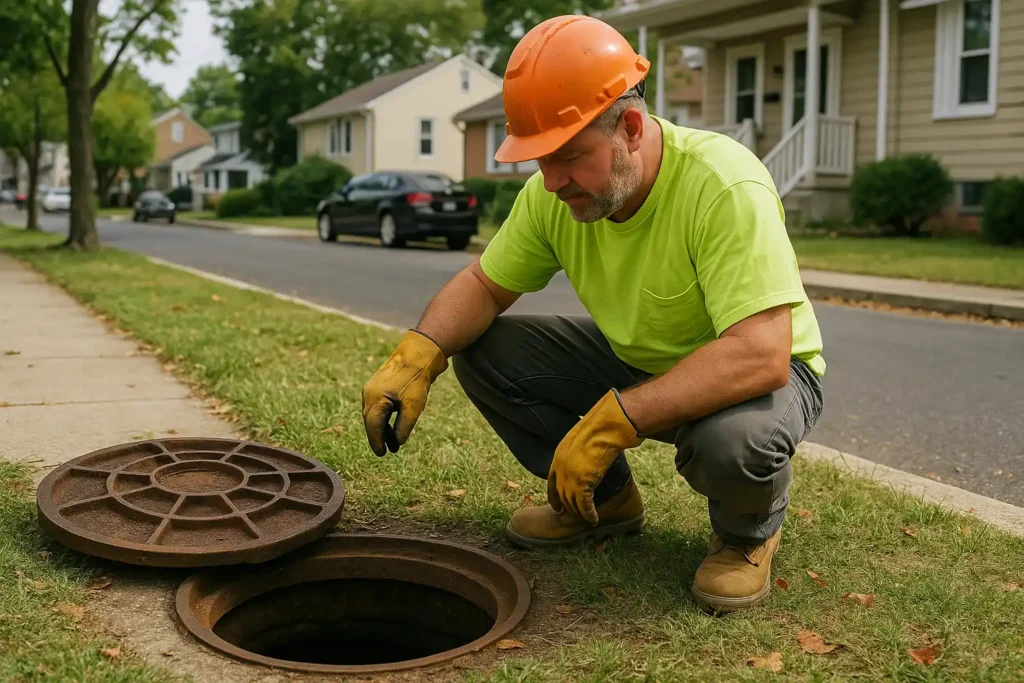
What We Check Inside a Manhole
The cover and frame come first. A loose, cracked, or badly seated cover is both a safety issue and a route for grit and surface water to wash into the system.
Then the chamber walls. We look for cracked joints between sections, missing mortar, corrosion on the top rings, and any place daylight or water is coming through.
The benching and invert at the bottom matter most for flow. A worn channel or a build of sediment changes how water moves and starts blockages downstream.
Last we watch the pipes. Every inlet and outlet gets checked for flow, for standing water backing into the chamber, and for debris caught at the opening.
Depth and dimensions get recorded as well. Knowing a chamber is nine feet deep with a twenty four inch opening decides what equipment any future work will need.
We check where the surface meets the frame. A gap between the ring and the pavement lets grit wash straight in, and that grit is what settles across the invert below.
Steps and ladders get checked whether or not anyone plans to enter. Corroded rungs are a hazard for the next person down, and finding that from the surface is the safe way to learn it.
Common Manhole Defects We Find
Sediment in the base is the most common finding. It settles out of slow flow, builds a shelf across the invert, and eventually pushes water into the wrong channel.
Groundwater coming in through the walls is the next. Staining, mineral streaks, or standing water during dry weather all point to a chamber taking water it should not.
Roots find manholes the same way they find pipe joints. A chamber with an open seam can grow a surprising root mass, and that mass catches everything drifting past.
Structural wear shows up as spalling concrete, exposed rebar, or steps that have rusted through. Any of those makes the chamber unsafe to enter and needs work booked.
Grease shelves form in chambers serving commercial kitchens. A hardened ring around the water line narrows the channel and traps everything that drifts past it.
Illicit connections turn up more often than owners expect. A downspout or a pump line tied into the wrong chamber overloads the system every time it rains hard.
Surcharge marks on the walls tell a story. A staining line well above the normal flow shows the chamber has filled at some point, which points at a restriction downstream.
How Often Manholes Should Be Inspected
An annual check suits most private manholes on commercial and multi-unit properties. It catches sediment buildup and cover wear before either causes a problem downstream.
Newly built structures deserve a look sooner. The first year or two is when settlement, bad joints, and construction debris show themselves.
Chambers under traffic get a shorter cycle. Delivery yards, parking areas, and access roads put load on covers and frames that a landscaped area never does.
After heavy rain is always worth a look. High flow moves sediment, shifts debris, and shows up weaknesses that a dry weather inspection can miss entirely.
Chambers on a known problem run deserve a shorter cycle. If a section of line has blocked before, the structures either side of it are the first place to look.
Before a property changes hands is another good moment. A buyer taking on a commercial site inherits every chamber on it, and a survey prices that risk properly.
Sites that have had construction nearby deserve an extra look. Heavy plant traffic and vibration move covers, crack rings, and shift the pipes entering the chamber.
One local crew for every drain, sewer, and pipe problem in Cherry Hill Township.
LICENSED, BONDED, AND INSURED IN CHERRY HILL TOWNSHIP, NJ
Inspection, cleaning, and repair all come from the same team. The Sewer Kings documents what we find, quotes a flat rate for the fix, and leaves the decision with you.
Safe Access and Confined Space Work
A manhole is a confined space, and that is not a formality. Gas can collect at the bottom, oxygen can be low, and neither one gives a warning you would notice in time.
Our crew sets up properly every time. Traffic control at the surface, atmospheric checks before entry, and a person topside who never leaves the opening.
A great deal can be inspected without entering at all. Pole cameras and lighting let us document the chamber from the surface, which is safer and often faster.
When entry is genuinely needed, it is done by trained crew with the right equipment. This is the part of the job where cutting corners has consequences nobody wants to read about.
Traffic control is part of the job on any chamber in a drive lane. Cones, signage, and a spotter keep both the crew and your tenants safe while the cover is open.
Covers go back seated properly. A lid dropped back crooked rocks under traffic, wears the frame, and becomes both a noise complaint and a trip hazard.
Everything gets photographed. Images of the invert, the walls, and the cover give you a reference point so the next inspection can show what has changed.
Why Choose The Sewer Kings for Manhole Inspection in Cherry Hill Township, NJ
Manhole work is equal parts inspection and safety. The Sewer Kings brings both to every Cherry Hill Township site we are called out to.
Documented, Not Just Looked At
Every inspection produces photos, notes, and a condition summary per structure. That record is what makes budgeting and planning possible.
Licensed, Bonded, and Insured
Confined space work is not a place for an uninsured contractor. Our crew is licensed in New Jersey and covered on every Cherry Hill Township job.
Cleaning and Repair Under One Roof
When an inspection finds sediment, a worn invert, or a failing frame, the same crew can put it right. No handing your site to a second company.
Around the Clock When a Chamber Backs Up
Overflowing chambers do not wait for business hours. Our crew answers 24 hours a day for commercial and multi-unit properties across Cherry Hill Township.

FAQs
Frequently Asked Questions About Manhole Inspection in Cherry Hill Township, NJ
The property owner is responsible for structures on the private side of the connection. The township maintains the public system. If ownership is unclear, our inspection report helps establish where the line divides.
Often not. A pole camera and proper lighting document most chambers from the surface. Entry is reserved for cases where something needs to be reached or measured directly.
It is priced per structure and depends on depth, access, and traffic control. Call The Sewer Kings at (856) 474-2746 with the number of chambers and we will quote a flat rate.
Book A Free Estimate
Submit your information below.
Related Plumbing Services in Cherry Hill Township, NJ
Drain Mapping in Cherry Hill Township
Knowing where every chamber and line sits comes first. Our drain mapping work records the full layout of a site with depths and connections.
Drain Tracing in Cherry Hill Township
When a chamber’s connecting pipes need following, drain tracing locates each run and confirms where it goes.