Drain Relining in Cherry Hill Township, NJ

5.0
& Yelp Reviews

Book A Free Estimate
Submit your information below.

Our Reviews

Why South Jersey Trusts The Sewer Kings


Book A Free Estimate
Submit your information below.
Repairing Drains From the Inside in Cherry Hill Township
Relining puts a new pipe inside the old one. A resin-saturated liner is drawn into the damaged run, pressed against the wall, and cured in place until it hardens.
It is the least disruptive repair we offer. Relining sits alongside the other drain and sewer services in Cherry Hill Township we provide, and it suits mature yards and finished driveways especially well.
The Sewer Kings relines laterals and drain runs for homes and businesses across the township. Every job starts with a camera survey, because relining only works when the host pipe still holds its shape.
It is worth being clear about what relining is not. It is not a coating sprayed down a pipe, and it is not a patch. It is a structural liner that carries the load once it has cured.
Relining suits a lot of Cherry Hill Township properties because so many have mature landscaping. Keeping a garden intact is worth real money when the alternative is a trench through it.
For a closer look, see our guide on drain relining vs. pipe replacement.
How Drain Relining Works
The line has to be clean first. We cut back roots, remove scale, and jet the run until the wall is bare, because a liner cannot bond to a dirty pipe.
Then the liner goes in. A felt or fiberglass tube saturated with resin is pulled or inverted into position and inflated so it presses tight against the existing wall.
Curing hardens it in place. Depending on the resin and the run, that happens with ambient time, hot water, steam, or ultraviolet light.
Finally we reopen any branch connections and camera the finished run. What you end up with is a jointless pipe inside the old one, sealed end to end.
Measuring comes before ordering. Liner diameter and length have to match the run exactly, because a liner that is too large wrinkles and one too small never seals.
We camera the cure. Checking the finished liner end to end is how we confirm there are no wrinkles, no gaps at the ends, and no blocked branch connections left behind.
Reinstating branches is precision work. A cutter is run to the liner and the junction is opened cleanly, which is the step that separates a proper job from a blocked branch.
When Relining Is the Better Choice
Relining wins whenever access is the expensive part. A line under a paved driveway, a mature garden, a patio, or a finished basement floor is a strong candidate.
It also suits pipe with many small faults. Hairline cracks and open joints along a whole run get sealed together instead of being patched one at a time.
Root problems respond well. A sealed liner leaves no joint for roots to enter, which removes the cause rather than cutting the same roots back every year.
It is quicker than an open cut on most jobs. One or two days on site with a couple of small access pits, rather than a week of trench, backfill, and restoration.
It protects mature landscaping. Trees, established beds, and hardscape that took years to grow in are worth far more than the small premium a liner sometimes carries.
Commercial sites value the shorter disruption. Keeping a parking lot open and a business trading matters as much as the pipe repair itself.
Lines under a finished basement floor are a strong case as well. Opening concrete inside a house is disruptive, dusty, and far more expensive than working from an access pit.
How Long a Relined Drain Lasts
Cured-in-place liners are engineered for a long service life, commonly quoted at fifty years or more by the manufacturers who make them.
The finished surface is smooth and jointless, which means less for grease and debris to catch on than the original pipe ever offered.
Care still matters. Keeping grease out of the kitchen line and running a camera check every few years is what gets a liner to its full design life.
Workmanship decides the rest. Proper cleaning, correct liner sizing, and a full cure are what separate a liner that lasts decades from one that fails early.
The host pipe keeps helping. A liner inside sound clay or iron works together with the original wall, which is part of why the finished repair is so durable.
Branch connections are a watch point. Where a liner covers a junction, that opening has to be reinstated cleanly, and sloppy work there is a common source of later trouble.
The liner also seals out groundwater. A pipe that had been taking water in through open joints stops doing it, which reduces the load on the whole system.
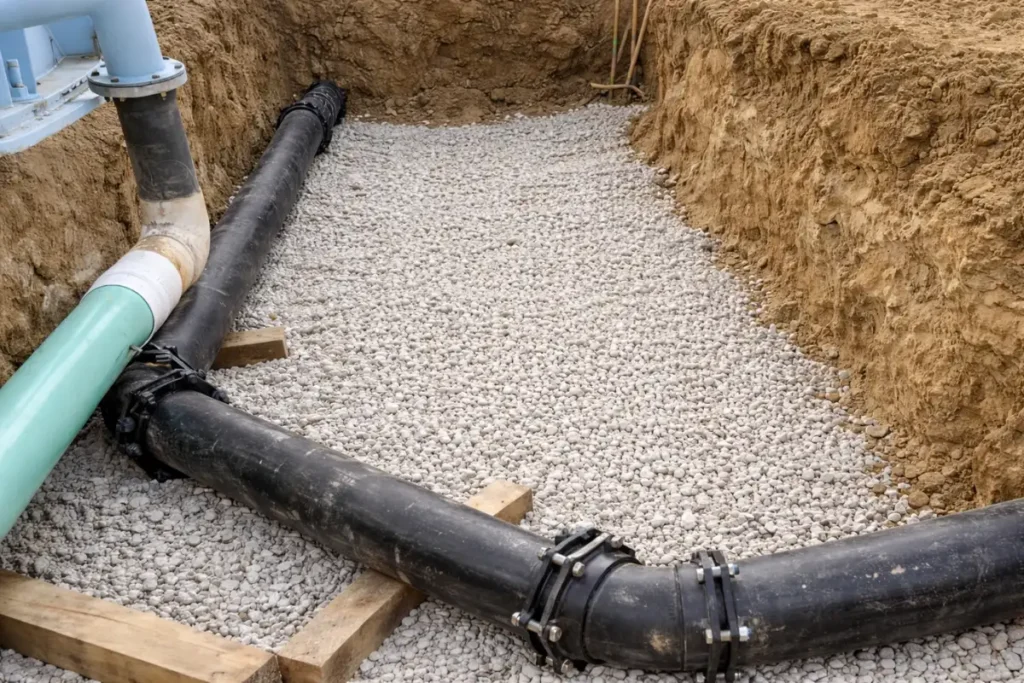
One local crew for every drain, sewer, and pipe problem in Cherry Hill Township.
LICENSED, BONDED, AND INSURED IN CHERRY HILL TOWNSHIP, NJ
Relining, excavation, and full replacement all come from the same crew. The Sewer Kings shows you the camera footage, explains the real options, and lets you decide.
What Relining Cannot Fix
A collapsed pipe is the clear exception. A liner needs a host pipe to press against, and a run that has caved in has nothing left to hold the shape.
Bellies stay bellies. Relining follows the existing line exactly, so a sagging section keeps its sag and keeps holding water afterward.
Badly offset joints can also rule it out. Where two pipe ends have shifted far apart, the liner cannot bridge the gap cleanly and an open cut is the honest answer.
Severe diameter loss is the last one. Every liner takes up some inside space, so a pipe already narrowed to a fraction of its bore may need replacing instead.
Collapses hidden behind a blockage are the trap. That is exactly why we clean and camera before quoting, rather than pricing a liner off a description over the phone.
We will quote both ways when the case is borderline. Seeing the cost of lining next to the cost of digging lets you make the call with real numbers in front of you.
We check for a belly before quoting. Standing water on the camera means the run has sagged, and pointing that out early saves you paying for a repair that leaves the problem in place.
Why Choose The Sewer Kings for Drain Relining in Cherry Hill Township, NJ
Relining is sold hard by a lot of companies and suits fewer jobs than the marketing suggests. The Sewer Kings tells Cherry Hill Township customers when it fits and when it does not.
We Say No When It Will Not Work
If the camera shows a collapse, a belly, or a bad offset, we will tell you relining is the wrong repair even though it is the bigger sale.
Cleaning Done Properly First
Most early liner failures trace back to a pipe that was not clean enough. We descale, cut roots, and jet the run before any liner goes in.
Licensed, Bonded, and Insured in New Jersey
Every relining job in Cherry Hill Township is carried out by a licensed crew working to state and local code, with the finished run recorded on camera.
A Flat Rate Quoted After the Camera, Not Before
We price relining once we have seen the pipe. That way the number holds, and you are not being quoted a range that grows once the work is underway.

FAQs
Frequently Asked Questions About Drain Relining in Cherry Hill Township, NJ
Most residential runs are completed in one to two days, including the cleaning and the cure. Longer commercial runs or lines with several branch connections take a little more.
Usually only small access pits at one or both ends, and often an existing cleanout is enough. It is far less digging than an open-cut repair of the same run.
A camera survey answers it. The pipe has to still hold its round shape with no major sag or offset. Call The Sewer Kings at (856) 474-2746 to book the survey.
Book A Free Estimate
Submit your information below.
Related Plumbing Services in Cherry Hill Township, NJ
Our Pipe Descaling Service
Before a liner goes in, old cast iron needs the scale taken back to bare metal. Our descaling work prepares the pipe so the liner bonds properly.
Cherry Hill Drain Excavation
When relining is ruled out, digging is the answer. Our excavation crew opens the smallest cut the repair allows and restores the ground afterward.