Drainage System Inspection in Cherry Hill Township, NJ

5.0
& Yelp Reviews

Book A Free Estimate
Submit your information below.

Our Reviews

Why South Jersey Trusts The Sewer Kings


Book A Free Estimate
Submit your information below.
Finding Out What Your Drains Are Really Doing
Most drainage problems get diagnosed by guesswork. A drain is slow, someone snakes it, and nobody ever looks at why the line filled up in the first place.
An inspection replaces the guess with footage. It is one of the drain and sewer services in Cherry Hill Township we run before any major repair, before a purchase, and any time a line keeps misbehaving.
The Sewer Kings inspects home laterals, yard drain networks, and commercial systems. You get video of the pipe, the location and depth of the problems, and a straight explanation of what each one means.
An inspection is also the cheapest way to settle a disagreement. When two contractors have given different answers, footage of the pipe tends to end the argument quickly.
Cherry Hill Township has a wide mix of housing ages, and drainage built in the 1950s behaves nothing like drainage built in the 1990s. The camera settles which one you own.
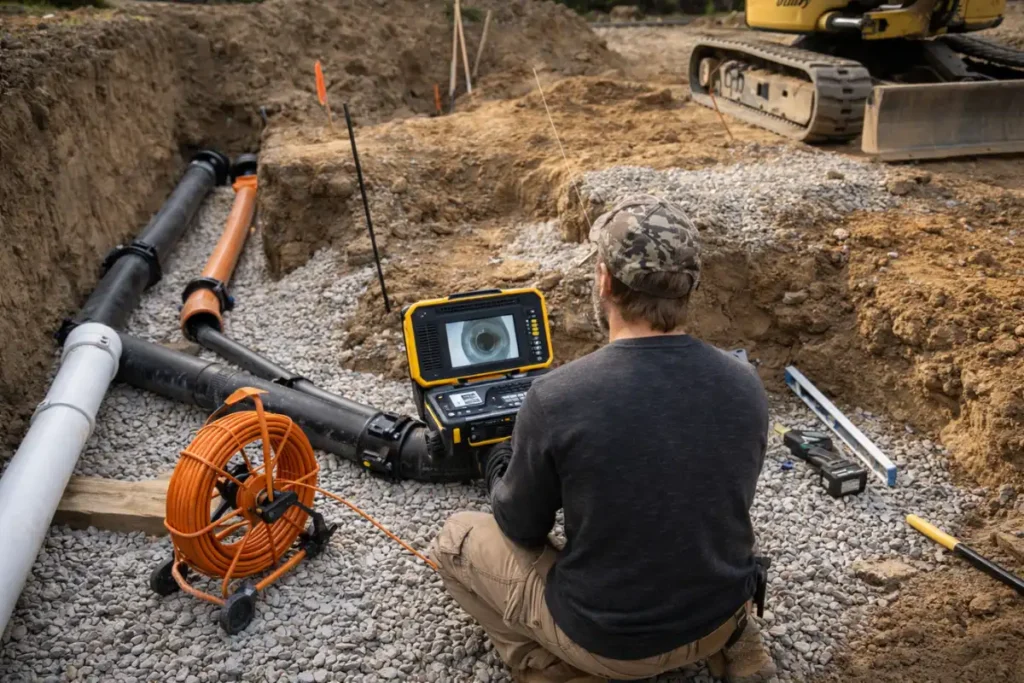
What a Drainage System Inspection Covers
We start above ground. Grates, basins, cleanouts, and access chambers get opened and checked, because a blocked opening explains a lot of surface water problems on its own.
Next we test how the system takes water. Running a real volume through the network shows where flow slows and where it pushes back, which points the camera work in the right direction.
Then the camera goes in. We record the full run, note the pipe material and diameter, and mark every defect with its distance from the access point.
Where a fault matters, we locate it precisely from the surface. Knowing a break sits eleven feet down the side yard at four feet deep turns a vague problem into a defined repair.
We record access points too. Knowing where every cleanout and chamber sits is half the value, because it makes every future visit faster and cheaper.
Pipe material gets identified as we go. Clay, cast iron, older fiber conduit, and PVC each fail differently, and knowing which you have shapes what happens next.
Interior and exterior get looked at together. A yard drain tied into a sanitary line, or a downspout feeding a lateral, only shows up when both sides are surveyed on the same visit.
The Camera Work and What It Shows
Cracks and offset joints show up plainly on video. An offset means the two pipe ends no longer line up, which catches solids and lets soil work its way in.
Standing water in the footage marks a low spot. That is a section that has sagged, and waste settles there instead of flowing on to the main.
Root intrusion looks like fine white threads at a joint early on, and like a curtain across the pipe once it has been growing for a few seasons.
Scale and grease build show as a narrowing of the opening. Measuring how much is left tells us whether a cleaning fixes it or something more is needed.
Grease and debris get judged by how much bore is left. A pipe running at half diameter is manageable, while one down to a quarter is close to blocking on the next heavy load.
Water flowing in from a joint during dry weather is a finding in itself. That means groundwater is entering the line, which loads the system and washes soil in with it.
Distance counting is what makes the footage useful. Every defect is logged by how far it sits from the access point, so the repair crew is not searching for it later.
When to Book an Inspection
Before buying a property is the big one. An older Cherry Hill Township home can have a failing lateral with no symptoms yet, and that is a bill you do not want to inherit blind.
Repeat blockages are the other clear trigger. When a line is cleaned properly and clogs again within months, something structural is causing it and only video will find it.
Before any digging or building work, an inspection tells you what is under the ground you are about to break. That is far cheaper than cutting a live line with a machine.
After heavy work nearby is worth it too. Excavation, heavy trucks, and new construction next door can shift or crack a line without anyone noticing at the time.
Insurance claims often need it. When a backup causes damage, a documented inspection showing the cause carries far more weight than a description written after the fact.
New landlords benefit early on. Inspecting at the start of ownership sets a baseline, so any later problem can be measured against a known starting condition.
Before finishing a basement is a smart time to book. Opening a wall or a floor later to reach a failing line is exactly the expense a survey beforehand avoids.
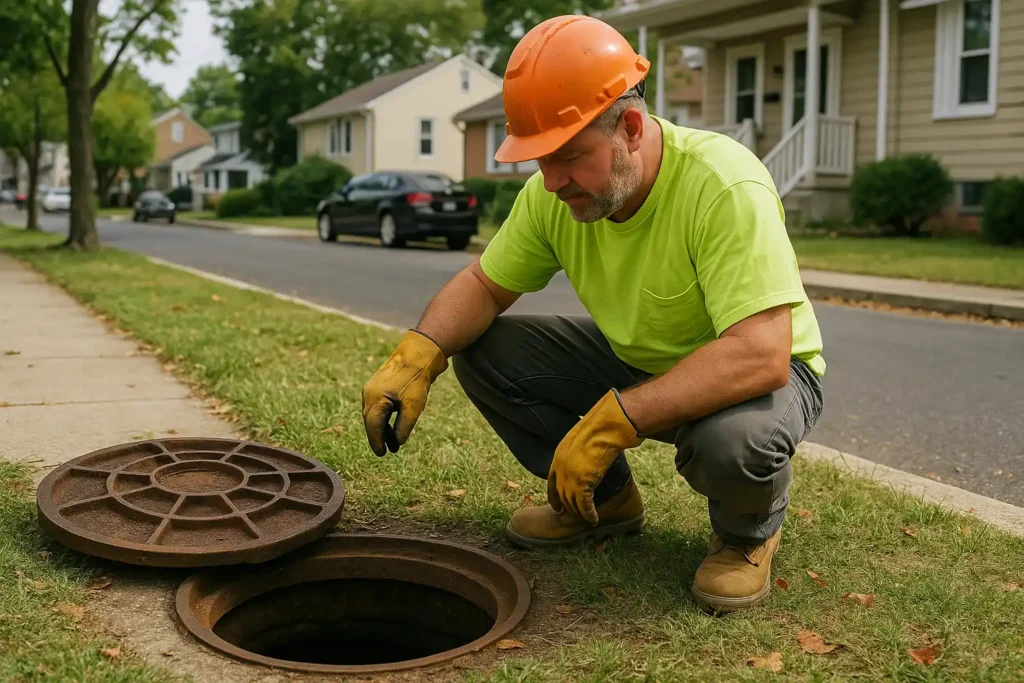
One local crew for every drain, sewer, and pipe problem in Cherry Hill Township.
LICENSED, BONDED, AND INSURED IN CHERRY HILL TOWNSHIP, NJ
We inspect, we explain, and we can do the repair with the same crew. The Sewer Kings gives you the footage and a flat rate, then leaves the decision with you.
Reading the Report and Deciding Next Steps
Every inspection ends with a written summary. Pipe material, diameter, length surveyed, and every defect with its distance and depth, in plain language rather than trade shorthand.
We group findings by urgency. Something that needs work this month reads differently from something worth watching at the next visit, and the report says which is which.
Where repair is needed, we lay out the real options. Cleaning, spot repair, lining, or replacement each have a cost and a lifespan, and you should hear all of them.
The report is yours to keep. Owners use it with insurers, buyers use it in negotiations, and landlords file it as proof the system was checked and documented.
We flag what is normal too. Older pipe always shows some wear, and knowing which findings are cosmetic saves owners from paying to fix things that are not broken.
Where we recommend work, the report says why. You should be able to point at a frame of video and understand exactly what you are being asked to spend money on.
We keep the file. If you come back in three years, we can compare the two surveys and tell you whether anything has actually changed or not.
Why Choose The Sewer Kings for Drainage System Inspection in Cherry Hill Township, NJ
An inspection is only useful if the person holding the camera explains what you are looking at. The Sewer Kings does that on every Cherry Hill Township survey.
You See the Footage
The video is not kept behind a counter. You watch the run with our tech, and you get a copy afterward with the written report.
Licensed, Bonded, and Insured in New Jersey
Every drainage system inspection in Cherry Hill Township is carried out by a licensed, bonded, and insured crew working to state and local code.
No Repair Pressure
Plenty of companies inspect for free and then sell a repair. We charge a fair flat rate for the survey and let the footage make the case, or not.
Family-Owned, Working Locally
Mark and Anthony Papaneri run the company and the crews. Inspections in Cherry Hill Township are done by people who work in this township every week.

FAQs
Frequently Asked Questions About Drainage System Inspection in Cherry Hill Township, NJ
A typical home survey takes one to two hours. Larger properties with several access points or long commercial runs take half a day. We confirm the time frame when we book.
Yes. You get the video and a written report with pipe material, defect locations, and depths. It is yours to share with a buyer, an insurer, or another contractor.
Usually yes. We can often enter through a removed toilet, a roof vent, or an outside access point. Call The Sewer Kings at (856) 474-2746 and we will work out the access first.
Book A Free Estimate
Submit your information below.
Related Plumbing Services in Cherry Hill Township, NJ
Manhole Inspection in Cherry Hill Township
Manholes and access chambers get their own detailed check. Our manhole inspection work covers the structure, the benching, and the flow through it.
Our Drain Mapping Service
When you need the whole layout on paper rather than one line on video, drain mapping records every run, junction, and depth across the property.